
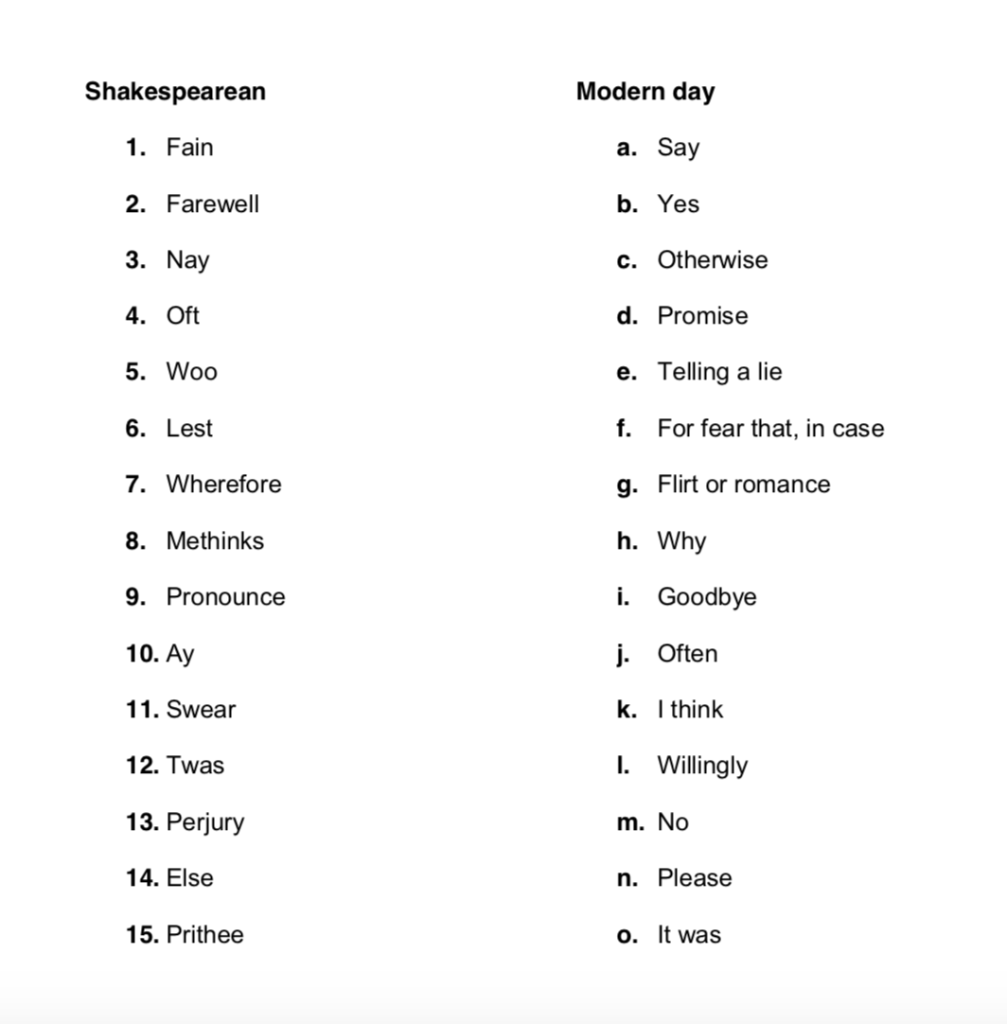
Do you know that Shakespeare also created many words and phrases? Here’s a fun video!

Welcome Back to Miss Atherly's English Class
Success is 1% inspiration and 99% perspiration.
Do you know that Shakespeare also created many words and phrases? Here’s a fun video!
For your Christmas Project you had to complete the following:
William Shakespeare – Mini Project
Directions: Conduct some research on the following. Answer the questions in your own words. Your project should be submitted in a folder and include a cover page and table of contents.
Due Date: Tuesday 7th January 2020
1. Who was William Shakespeare?
– Where was he born?
– Where did he live?
– What did his parents do?
– Details of any wife or children, when he started writing, his path to fame, his later years.
2. Shakespeare’s works
– Shakespeare wrote three types of plays: comedies, tragedies and histories.
– Describe each style and give one example of each.
3. Describe Shakespeare’s theatre:
– What did it look like? – You may include a picture.
– Who were the actors?
4. Shakespeare’s times:
– How did people live at the time?
– Life expectancy, religion
– What did people do for entertainment?
Presentation – 10 marks (Was a folder included? Were there pictures? Was it neatly presented?)
Content – 20 marks – 5 marks per section (Did you include all the necessary information?)
Clarity of Content – 10 (Were you able to explain the content clearly?)
Items: 41–50
Instructions: Read the following passage carefully and then answer Items 41–50.
My Madonna1 cried. A miniature teardrop travelled down her white porcelain face, like dew on the tip of early morning grass. When I saw the tear I thought, surely that my mother had died.
I sat motionless observing the Madonna the whole day. It did not shed another tear. I remained in the rocking chair until it was nightfall, my bones aching from the thought of another trip to the prison in Port-au- Prince. But, of course, I had to go.
The sun was just rising when I got to the capital. The first city person I saw was an old woman carrying a jar full of leeches. Her gaze was glued to the Madonna tucked under my arm.
“May I see it?” she asked.
I held out the small statue that had been owned by my family ever since it was given to my great-great-great-grandmother Defile by a French man who had kept her as a slave.
The old woman’s index finger trembled as it moved towards the Madonna’s head. She closed her eyes at the moment of contact, her wrists shaking.
“Where are you from?” she asked. She had layers of ‘respectable’ wrinkles on her face, the kind my mother might also have one day, if she had a chance to survive.
“I am from Ville Rose,” I said.
“You’re here to see a prisoner?” she asked.
“Yes.”
“I know where you can buy some very good food for this person.”
She led me by the hand to a small alley where a girl was selling fried pork and plantains wrapped in brown paper. I bought some meat for my mother after asking the cook to fry it once more and then sprinkle it with spiced cabbage.
The yellow prison building was like a fort, as large and strong as in the days when it was used by the American marines who had built it. The prison yard was as quiet as a cave when a young Haitian guard escorted me there to wait. The smell of the fried pork mixed with that of urine and excrement was almost unbearable. I sat on a pile of rocks trying to keep the Madonna from sliding through my fingers.
The other prisoners had not yet woken up. All the better, for I did not want to see them, these thin-boned women with shorn heads, carrying clumps of their hair in their bare hands, as they sought the few rays of sunshine that they were allowed each day.
My mother had grown even thinner since the last time I had seen her. Her face looked like the grey of a late evening sky. These days, her skin barely clung to her bones, falling in layers, flaps on her face and neck. The prison guards watched her more closely because they thought that the wrinkles resulted from her taking off her skin at night and then putting it back on, in a hurry, before sunrise. This is why mother’s sentence had been extended to life. And when she died, her remains were to be burnt in the prison yard, to prevent her spirit from wandering into any young innocent bodies.
Adapted from Edwidge Danticat, “Nineteen Thirty-Seven”. In The Oxford Book ofCaribbean Short Stories, Oxford University Press, 1999, pp. 447–455.
1 Madonna — A representation of Mary either alone or with her child, Jesus.
41. The MAIN purpose of the opening paragraph (lines 1–2) is to
(A) create self-pity
(B) personify the Madonna
(C) set the mood of the passage
(D) foretell the mother’s death
42. Which of the following MOST clearly describes the narrator’s feelings about her trips to the prison?
(A) Resigned
(B) Relieved
(C) Reserved
(D) Receptive
43. Which of the following is the BEST explanation of the reaction of the old woman in lines 11 and 12 to the Madonna?
(A) She is old and sick and trembles because she is unable to stay still.
(B) She seems to value the family heirloom and has some kind of religious connection to it.
(C) She shakes because she is angered by the callousness that brought slavery into being.
(D) She has flashbacks of the horror of slavery and trembles as
44. In the passage, the Madonna functions as a
(A) foil
(B) symbol
(C) paradox
(D) caricature
45. Which of the following expressions is used figuratively?
(A) “like dew on the tip of early morning grass” (lines 1–2)
(B) “The sun was just rising when I got to the capital” (line 6)
(C) “my bones aching from the thought of another trip to the prison” (line 4)
(D) “index finger trembled as it moved towards the Madonna’s head”(line 11)
46. Which of the following words BEST describes the relationship between the narrator and her mother?
(A) Loving
(B) Dutiful
(C) Distant
(D) Fearful
47. What effect does the writer achieve by comparing the old woman and the mother in lines 7–19?
(A) The characters appear to be believable and interesting.
(B) The negative effects of ageing is reinforced as a theme.
(C) The stereotypical attitude of lonely old people is highlighted.
(D) The similarities and differences between the women are revealed.
48. The statement “The prison yard was as quiet as a cave” (line 23) suggests that the
(A) prison was silent and dark
(B) prison was peaceful and enclosed
(C) prisoners were voiceless and confined
(D) prisoners led quiet and superficial lives
49. What does “Her face looked like the grey of a late evening sky” (lines 29–30) suggest about the mother’s state of mind?
(A) She is anxious.
(B) She is confused.
(C) She is depressed.
(D) She is contented.
50. The final paragraph of the passage reveals PRIMARILY that the mother is
(A) so thin that her hair fell out
(B) fiercely protective of her family
(C) unhealthy and untrustworthy
(D) unwell and feared by her jailors
English B class is now online! This blog will be used for sharing information about the material you’re learning in class. In addition, you will have the chance to discuss and share ideas. Let’s have some fun!
Comment “Hello!” below if you can read this post.
 Welcome Back to Miss Atherly's English Class